Launch offer — valid today only

📄 Digital book in PDF · read it on your phone or print it

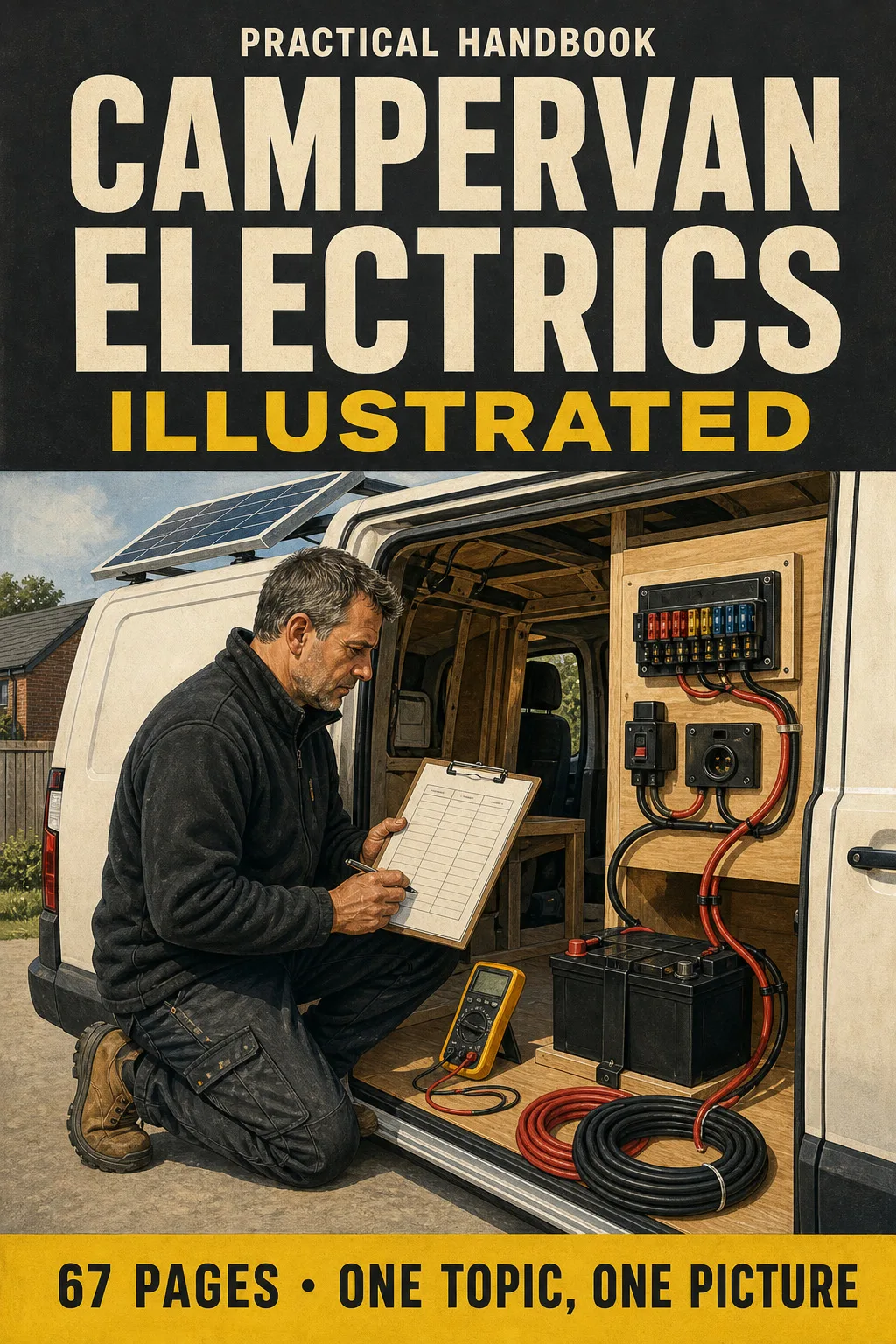
Your Campervan's 12 V System in Drawings One Topic on Every Page

Leisure batteries, fuses, cable sizing, split charging, solar and multimeter fault finding, for UK vans: cable in mm², 230 V hook-up, solar sized for UK seasons. Every topic has its own page: the drawing first, then the numbers to remember. 67 illustrated pages.

GET MY 12 V SYSTEM IN DRAWINGS

🔒 Secure checkout · PDF by email · 30-day guarantee

Every topic, its own pageEach sizing rule drawn, with the worked example beside it
67 illustrated pages8 parts, from volts, amps and watts to the build order checklist
Up-to-date sourcesChecked against BS EN 1648-2 (12 V in motorhomes), BS 7671 Section 721 (hook-up) and maker data sheets
PDF by emailFormat

Look Inside the Book

Every page has one big drawing and a box with the numbers and rules you need to know:

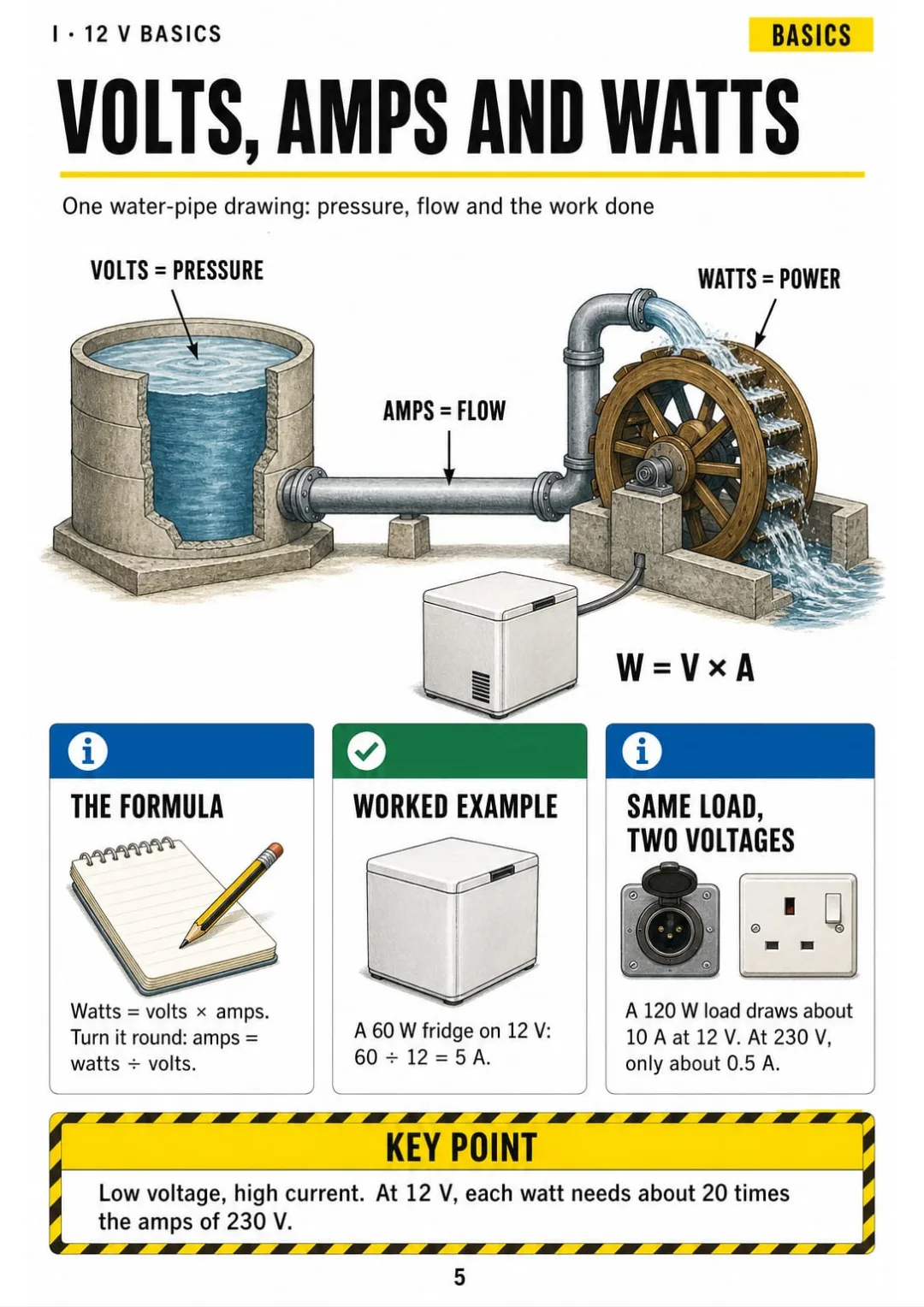
A 60 W fridge at 12 V draws 5 A: watts = volts × amps.
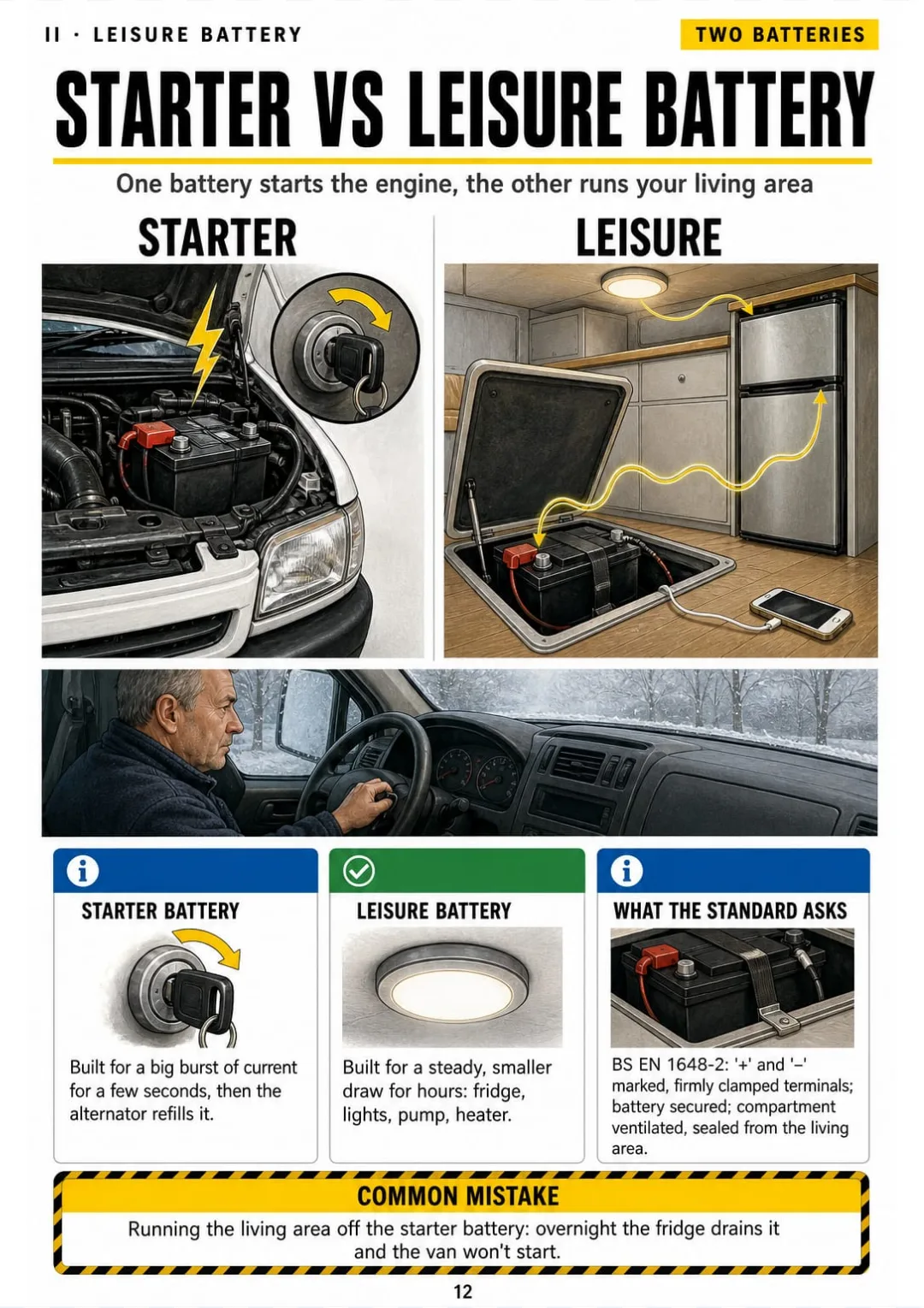
Starter battery: a burst for seconds. Leisure battery: a steady draw for hours.
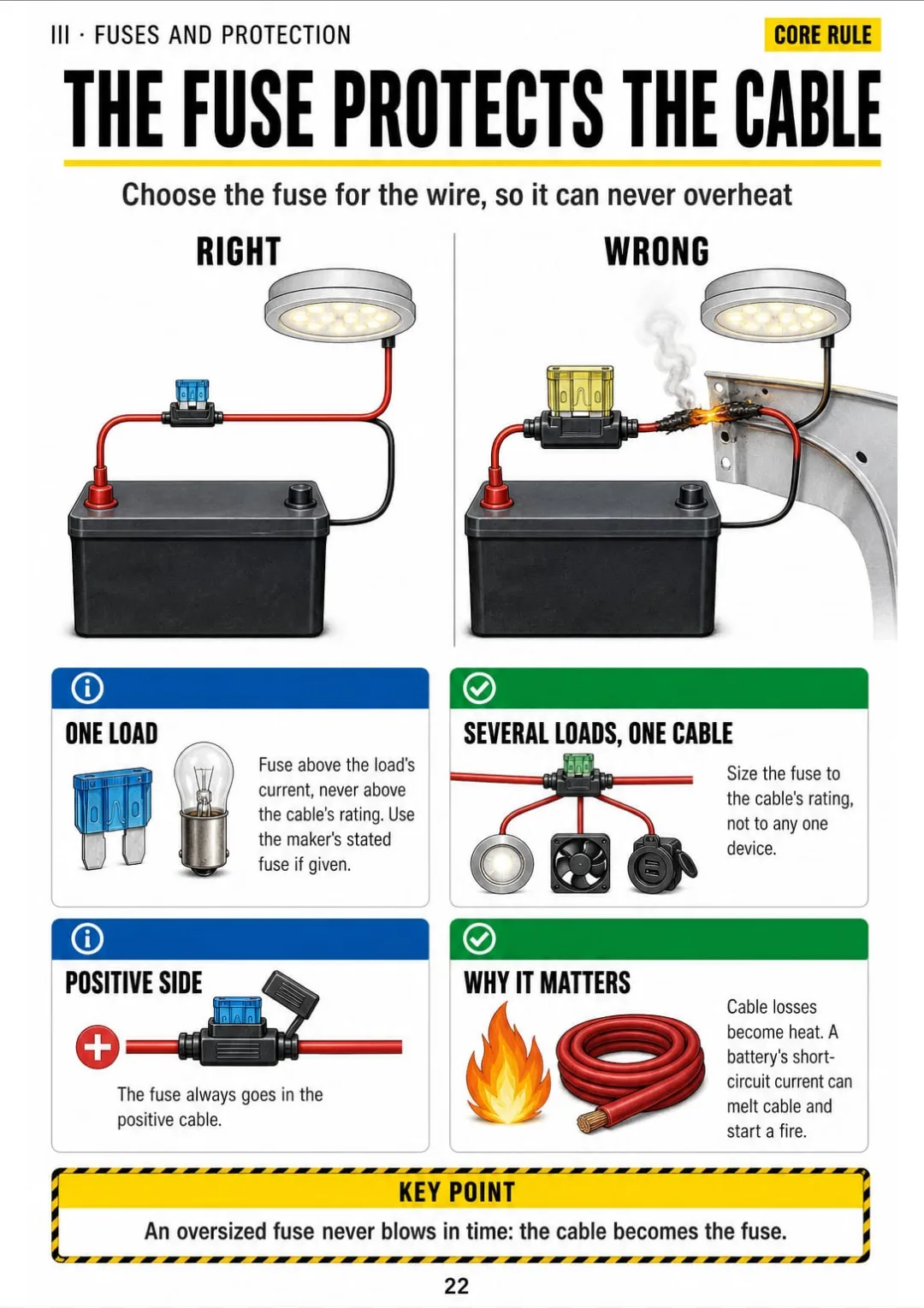
One load: fuse above its current, never above the cable's rating. Several loads: the cable's rating.
AWG to mm² card: 10 AWG ≈ 6 mm², 4 AWG ≈ 25 mm², rounded up
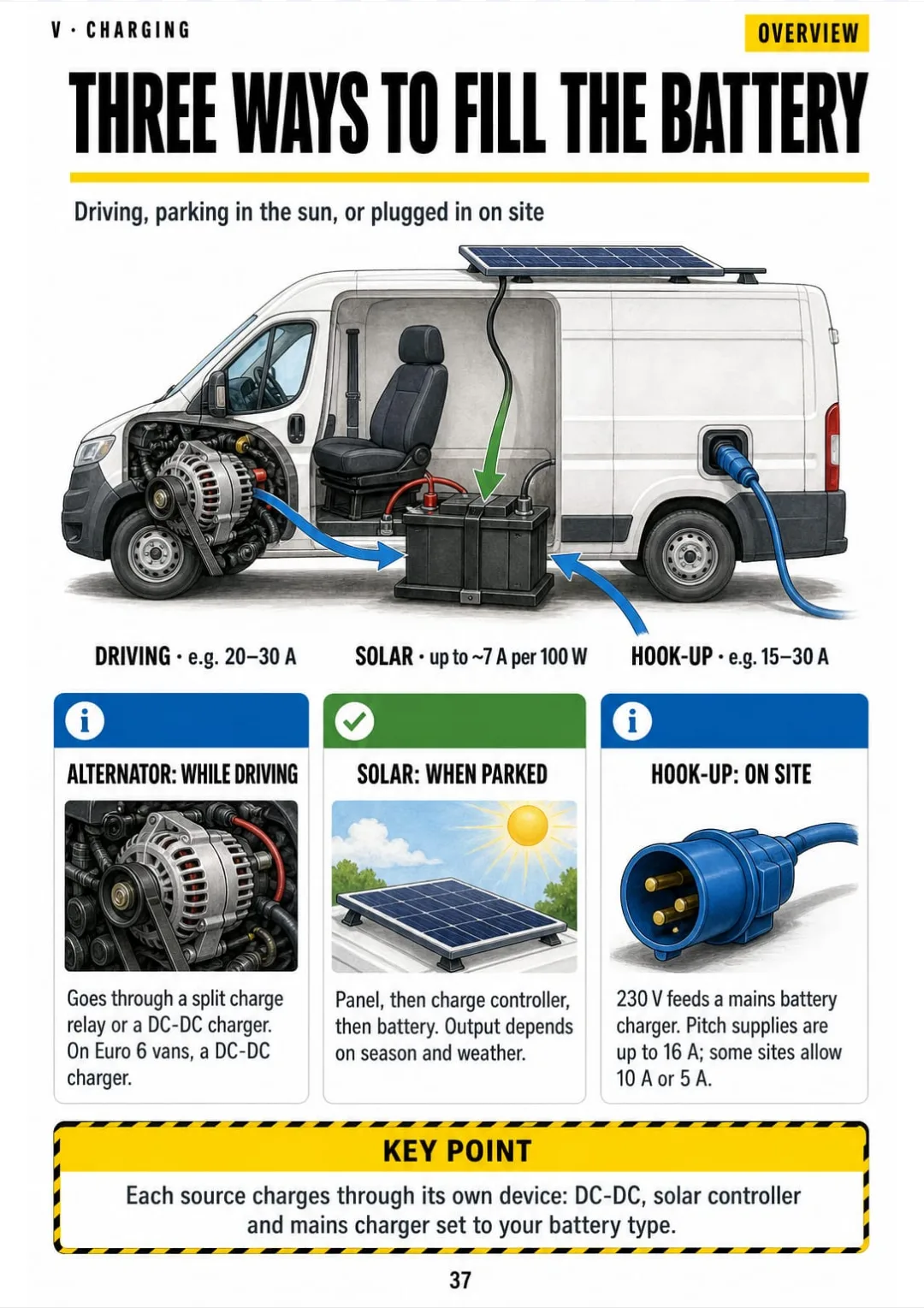
Alternator, solar and hook-up: three arrows into one leisure battery
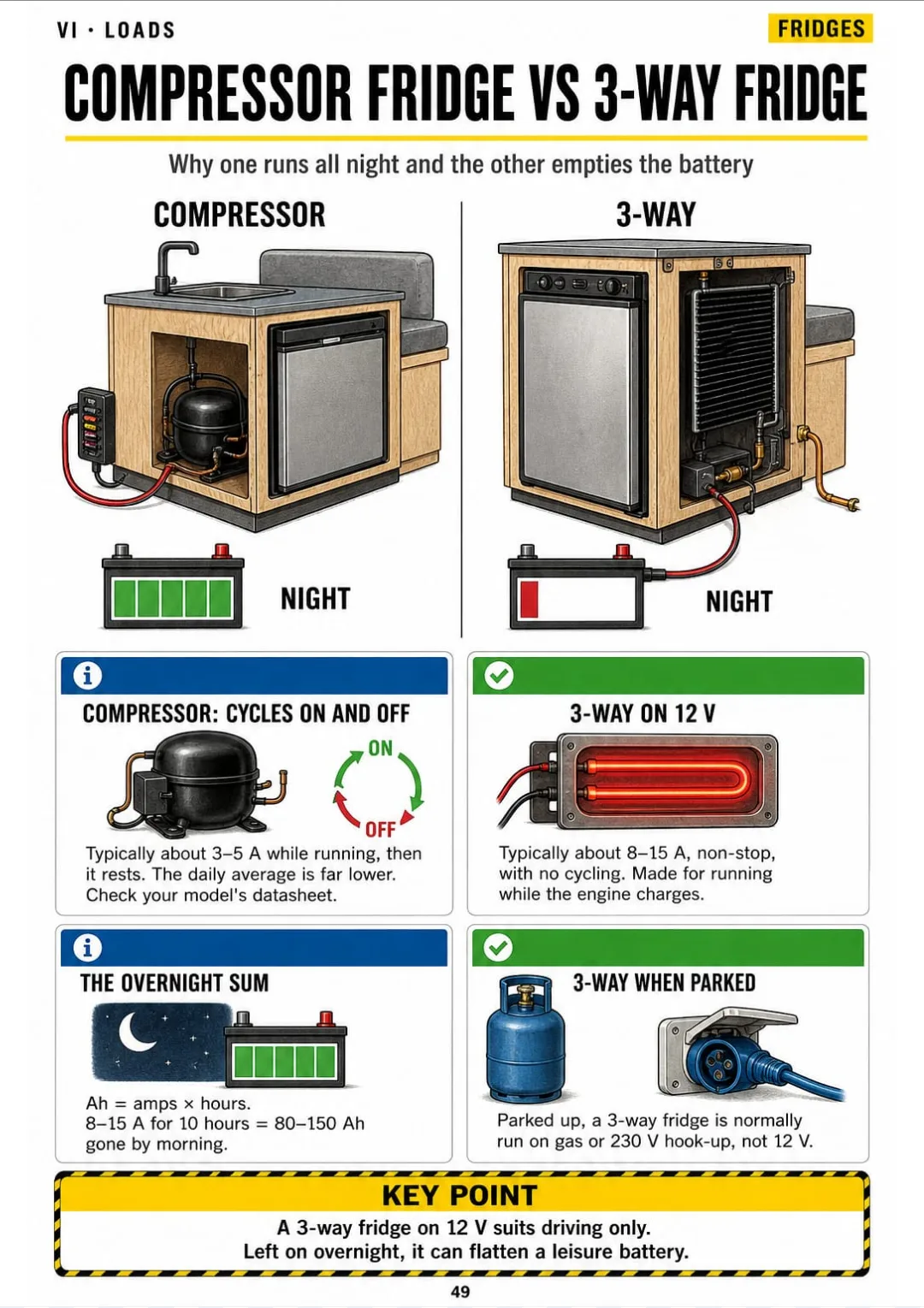
Compressor fridge: about 3–5 A while running. 3-way on 12 V: about 8–15 A, non-stop.
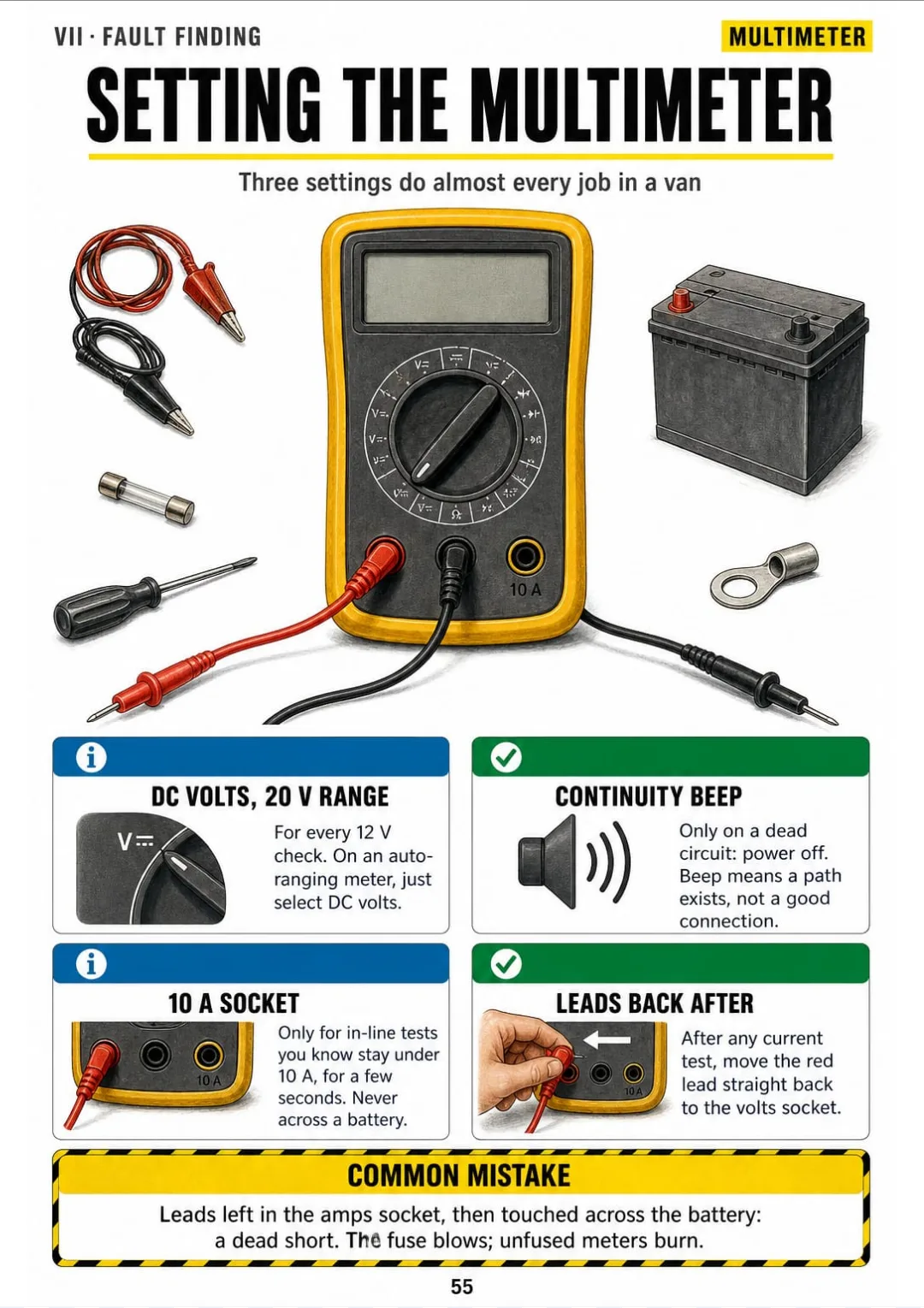
DC volts on 20 V, continuity on dead circuits, 10 A socket only under 10 A
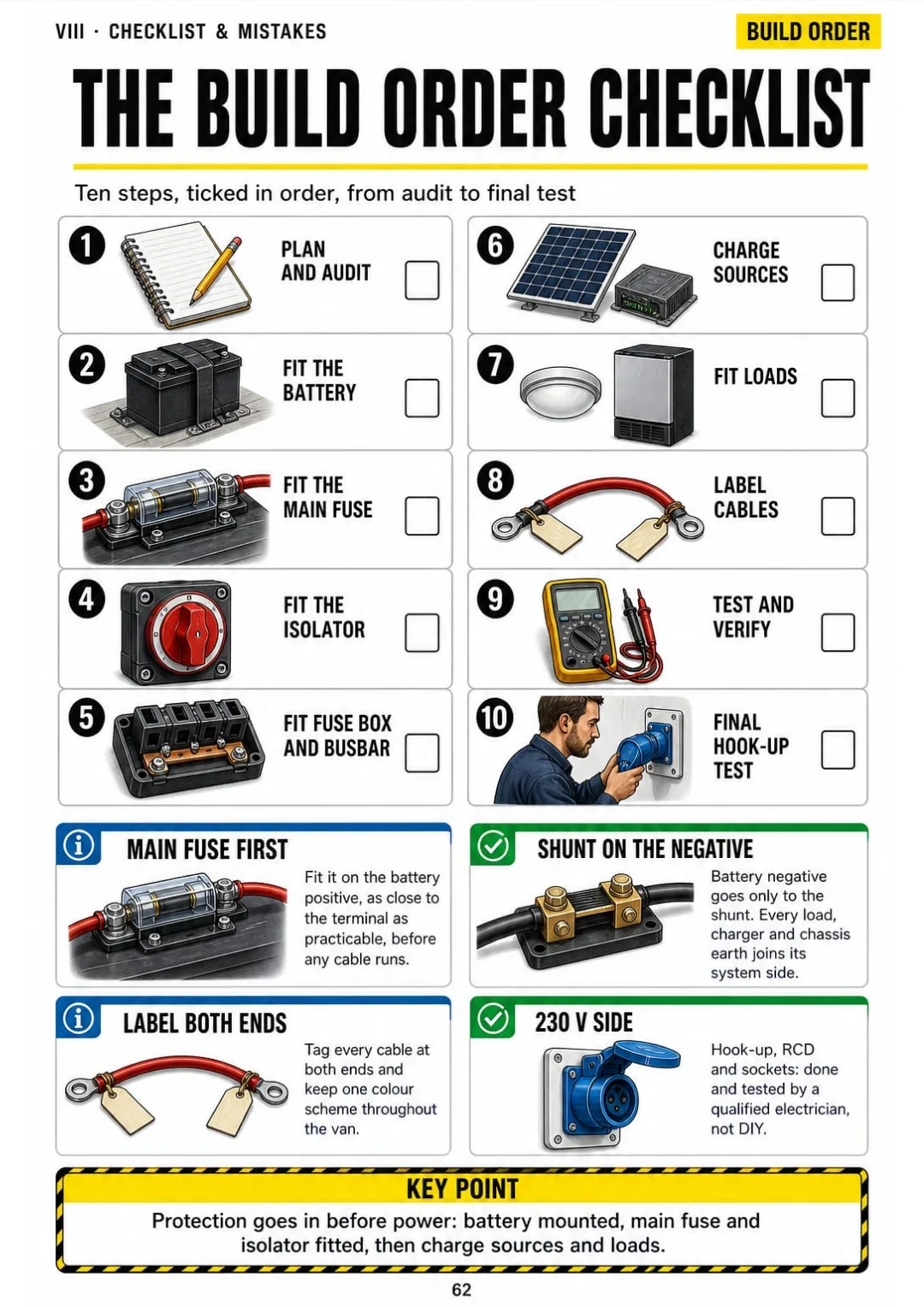
Ten steps from energy audit to multimeter test, with the 230 V side left to an electrician.

Swipe to see more →

These are real pages from the book. The table of contents is the full one: 8 parts and 63 topics.

The Problem Isn't You. It's How It Was Explained to You.

You're kneeling by the fuse box with a new 12 V fridge to wire in, about to pick the fuse from the sticker on the fridge. Is that the right number, or just the one the last video used?

The manual explains protection in long paragraphs: rated current, cable capacity, fault current. By the third line you've lost track of which number goes where.

One load: fuse above its current, never above the cable's rating. Several loads: the cable's rating.

In the book it's one page: the cable drawn from the battery to the load, the fuse sitting at the start of it, and a box with the rule. One load: fuse above its current, never above the cable's rating. Several loads: the cable's rating.

Every other decision has its own page too: the main battery fuse, sizing a fuse with a worked example, voltage drop on a 5-metre run, the DC-DC charger wired step by step, a fuse that keeps blowing.

You look at the drawing, choose the rating and fit it. No going back to the forums to check one more time.

COMPARE FOR YOURSELF

The Same Topic, Two Ways to Learn It

THIS
  • Ten videos, ten different fuse sizes
  • A forum diagram you can't check
  • You set off on the trip still unsure
Lead-acid batteries intended for engine starting are constructed with a greater number of thinner plates in order to maximise the surface area available for electrochemical reaction, thereby permitting the delivery of a high current over a period of a few seconds. Batteries intended for leisure or deep-cycle applications, by contrast, employ thicker plates and denser active material, which allow a sustained discharge at moderate current over many hours and tolerate repeated cycling to a greater depth of discharge without the premature loss of capacity observed in starter batteries.
FOR THIS
  • Starter vs leisure battery in one drawing
  • The key numbers in a box
  • You see it and you get it
Starter battery: a burst for seconds. Leisure battery: a steady draw for hours.
CONTENTS

Take a Look at the 8 Parts and 63 Topics

12 V basics, the leisure battery, fuses and protection, cable, charging, loads, multimeter fault finding and the build checklist: 67 pages, all illustrated

I12 V without the jargon · pp. 5-11
  1. Volts, amps and watts in one picture
  2. Amp-hours and watt-hours: the fuel in your tank
  3. Ohm's law for van builders
  4. The system map, in build order
  5. Reading a wiring diagram
  6. Why a 12 V battery can still start a fire
  7. The tool kit that does the job
IIThe leisure battery · pp. 12-21
  1. Starter battery vs leisure battery
  2. Flooded, AGM, gel or lithium (LiFePO4)
  3. Usable capacity: the 50 % rule
  4. State of charge from the resting voltage
  5. The energy audit: what your van uses in a day
  6. Sizing your battery from the audit
  7. Series and parallel batteries
  8. Where the battery lives
  9. Battery monitor and shunt
  10. Lithium: BMS and cold charging
IIIFuses and protection · pp. 22-28
  1. The fuse protects the cable, not the gadget
  2. The main battery fuse: as close as possible
  3. Fuse types and where each one goes
  4. Sizing a fuse: the worked example
  5. Fuse box and busbars
  6. The battery isolator switch
  7. The negative side: earths that work
IVCable: size, drop and connections · pp. 29-36
  1. mm², not AWG
  2. Current rating: how hot the cable gets
  3. Voltage drop: the number forums skip
  4. Voltage drop worked: the 5-metre run
  5. Choosing the cable: rating and drop together
  6. Colours and labels
  7. Crimping a lug properly
  8. Routing through the body
VCharging: alternator, solar and hook-up · pp. 37-48
  1. Three ways to fill the battery
  2. The split charge relay (VSR)
  3. Smart alternators and Euro 6 vans
  4. The DC-DC (battery-to-battery) charger
  5. Wiring the DC-DC step by step
  6. Solar panels: rigid, flexible and the roof
  7. MPPT vs PWM controllers
  8. Solar sizing for UK seasons
  9. Panels in series or parallel, and the cold-voltage trap
  10. Solar wiring order and fusing
  11. Hook-up: what the 230 V side looks like
  12. The mains battery charger
VILoads: what uses the power · pp. 49-54
  1. Compressor fridge vs 3-way fridge
  2. Lights, USB and the small stuff
  3. Water pump and diesel heater
  4. Inverters: watts at 230 V means big amps at 12 V
  5. Sizing the inverter cable and fuse
  6. Switches, relays and remote control
VIIFault finding with a multimeter · pp. 55-61
  1. Setting the multimeter
  2. The method: always in the same order
  3. Voltage drop test under load
  4. The battery that's flat every morning
  5. Leisure battery not charging while driving
  6. Solar not charging
  7. A fuse that keeps blowing
VIIIBuild checklist and frequent mistakes · pp. 62-67
  1. The build order checklist
  2. Frequent mistakes: cables and fuses
  3. Frequent mistakes: charging and batteries
  4. Pre-trip check
  5. Laying up for winter
  6. When to call a professional

One Page, One Topic, All Clear

Think of it this way:

It's the second morning on a site in the Lakes and the battery monitor reads lower than it should. You need to know where the amp-hours went.

You open the book at the page for the battery that's flat every morning: the battery drawn with the meter on it, the checks in the order you do them, and a box with what each reading means.

Alternator, solar and hook-up: three arrows into one leisure battery

The same goes for the energy audit, compressor vs 3-way fridges, solar sizing for UK seasons, the split charge relay and the 10 A socket on your multimeter: each one on its own page.

Campervan Electrics Illustrated is 8 parts and 63 topics, all drawn, ending with the build order checklist, the frequent mistakes, and the pre-trip and winter lay-up checks.

What you see drawn, you don't have to memorize.

What's Inside Campervan Electrics Illustrated:

Ipp. 5-11

12 V without the jargon

Volts, amps and watts in one picture, amp-hours, Ohm's law, the system map in build order, reading a diagram, fire risk and the tool kit.

IIpp. 12-21

The leisure battery

Starter vs leisure, flooded, AGM, gel and LiFePO4, the 50 % rule, resting voltage, the energy audit, battery sizing, series and parallel, the shunt and lithium cold charging.

IIIpp. 22-28

Fuses and protection

Why the fuse protects the cable, the main battery fuse, fuse types, a worked sizing example, fuse box and busbars, the isolator switch and the negative side.

IVpp. 29-36

Cable: size, drop and connections

mm² instead of AWG, current rating, voltage drop and the 5-metre worked run, choosing the cable, colours and labels, crimping and routing.

Vpp. 37-48

Charging: alternator, solar and hook-up

Alternator, solar and hook-up, the VSR, smart alternators, the DC-DC charger step by step, panels, MPPT vs PWM, UK solar sizing, the cold-voltage trap and the 230 V side.

VIpp. 49-54

Loads: what uses the power

Compressor vs 3-way fridges, lights and USB, water pump and diesel heater, inverters with their cable and fuse, switches and relays.

VIIpp. 55-61

Fault finding with a multimeter

Setting the multimeter, the method in the same order, voltage drop under load, and four faults: flat battery, no charge while driving, no solar, a fuse that keeps blowing.

VIIIpp. 62-67

Build checklist and frequent mistakes

The build order checklist, frequent mistakes with cables, fuses, charging and batteries, the pre-trip check, winter lay-up and when to call a professional.

At the end of the book: Worked sizing examples with blank worksheets for your own van, plus the build order checklist.
Plus: 2 Free Books

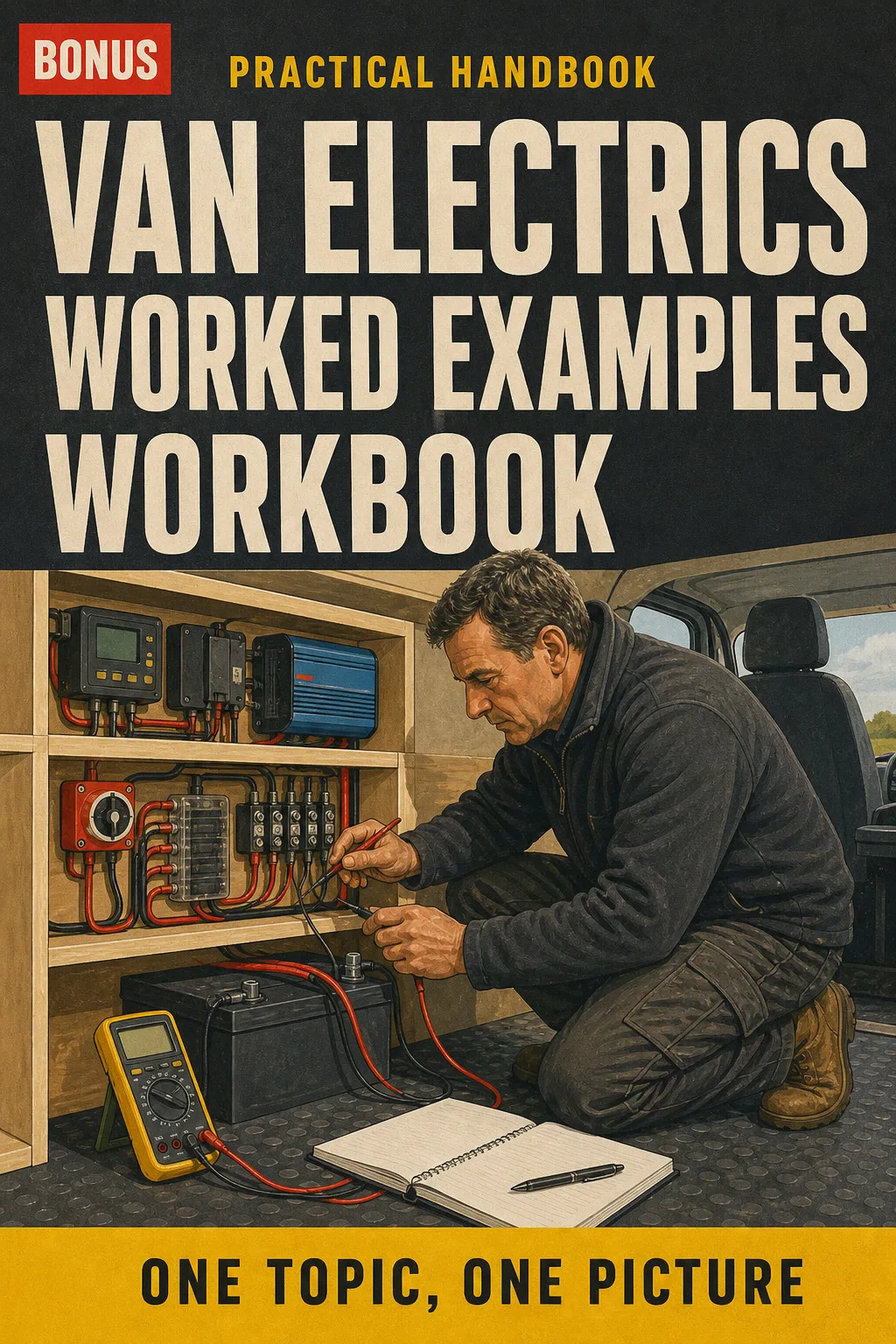
Van Electrics Worked Examples Workbook

BONUS 1: «Van Electrics Worked Examples Workbook»

Value on its own: US$ 17.90

Practise the sums before you buy a single part: energy audits, solar sizing, cable size and voltage drop exercises, with the answers drawn out step by step.

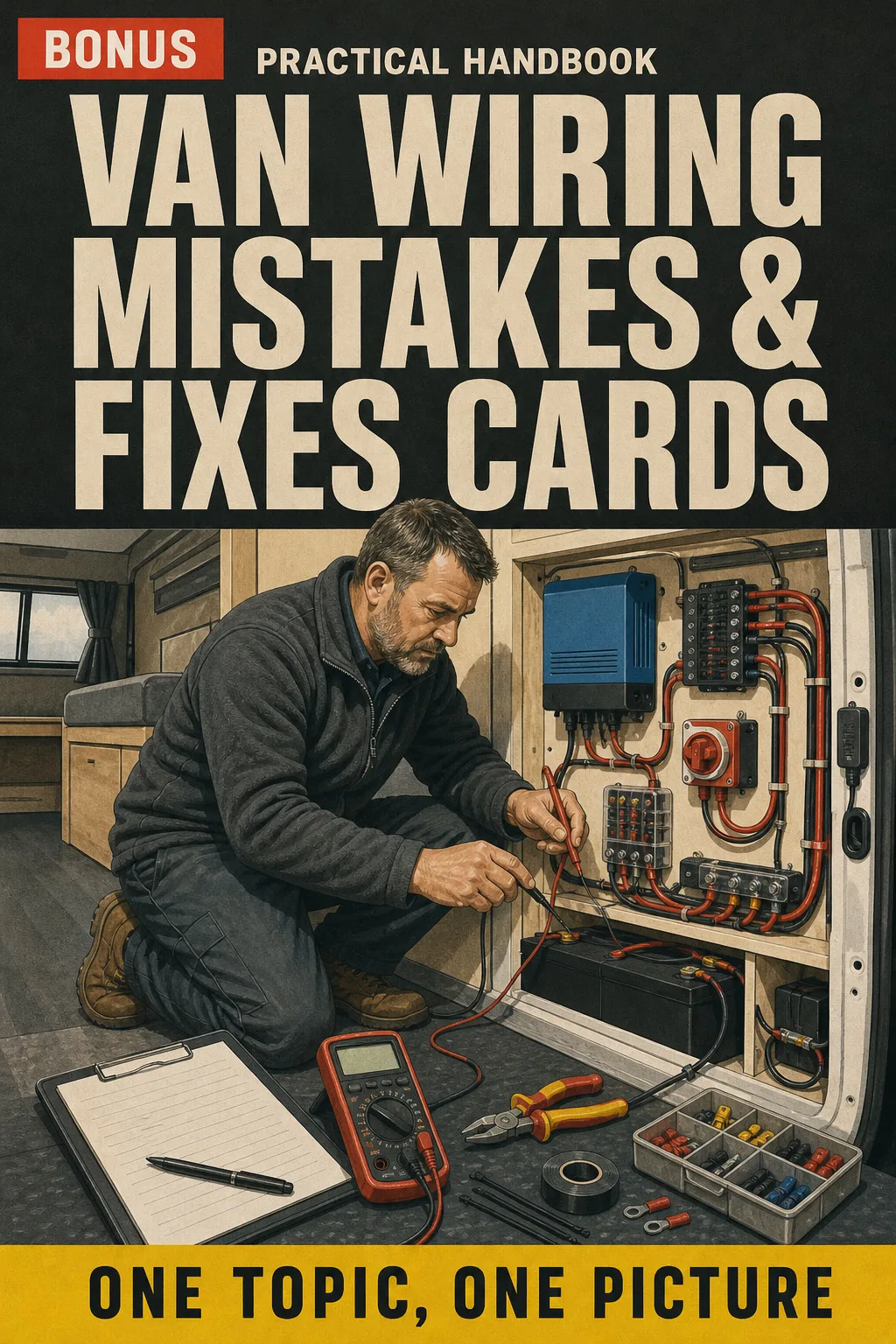
Van Wiring Mistakes & Fixes Cards

BONUS 2: «Van Wiring Mistakes & Fixes Cards»

Value on its own: US$ 14.90

The most frequent 12 V wiring mistakes on printable cards, each shown wrong and right, so you can check your own install at a glance.

Campervan Electrics Illustrated with 2 Free Books

  • Campervan Electrics Illustrated: 67 illustrated pagesUS$ 63
  • BONUS 1: Van Electrics Worked Examples WorkbookUS$ 17.90
  • BONUS 2: Van Wiring Mistakes & Fixes CardsUS$ 14.90
  • High-resolution PDF to printIncluded
Total value US$ 95.80
YOUR PRICE:
US$ 27
You save US$ 68.80
YES, I WANT CAMPERVAN ELECTRICS ILLUSTRATED FOR US$ 27

📄 This is a digital PDF book sent to your email: nothing is printed or shipped.

Secure purchaseEncrypted payment30-day guarantee

PDF by email: We email you Campervan Electrics Illustrated as a PDF, together with the two free books. It's a single payment: no installments, no extra charges.

Who This Book Is For

Planning your van conversion

Planning your van conversion

You see the whole system in build order before you buy a single part, and work out battery, solar and cable sizes with your own numbers.

A trip is coming up

A trip is coming up

You check fuses, charging and battery against the drawn pages, then run through the pre-trip check before you leave.

Your van is already wired

Your van is already wired

You check the install you copied from a forum, page by page, and find faults with the multimeter in the same order every time.

Everything You Get Today

US$ 95.80US$ 27
YES, I WANT CAMPERVAN ELECTRICS ILLUSTRATED FOR US$ 27

📄 This is a digital PDF book sent to your email: nothing is printed or shipped.

30DAYS
GUARANTEE

30-Day Guarantee

Try Campervan Electrics Illustrated for 30 days, bonus books included.

We refund everything if the file won't open, if the book isn't what you see here, if you were charged twice or if the email doesn't arrive. Just email us.

You pay once. No subscriptions.

Frequently Asked Questions

Is it for me if I've already wired part of my van?

Yes. It starts from volts and amps, but every page gets to the numbers you need: fuse ratings, cable sizes, voltage drop. If you've wired something, you'll use it to check your work; if you haven't, the build order takes you through it.

Where does the content come from?

From BS EN 1648-2 for 12 V installations in motor caravans, BS 7671 Section 721 for the 230 V hook-up side, and manufacturer data sheets. Wherever a standard or data sheet is cited, the page reminds you to check the current edition. Metric units throughout.

Is it official material?

No. It's an independent illustrated guide, not published, approved or endorsed by any standards body or manufacturer.

Does it replace training or a qualified electrician?

No. It helps you understand and plan your 12 V system. The 230 V side (hook-up, inverter to sockets) is shown only as an overview and must be done by a qualified electrician.

Are the practice exercises taken from a course or exam?

No. The worked examples and exercises are written for this book, to practise the sums on a typical van.

When and how does it arrive?

The book and the 2 bonus books arrive as PDFs by email, to the address you enter at checkout.

Do I have to pay every month?

No. It's a one-off payment, with no subscription.

Can I have it on paper?

Yes. The PDF is printable: print the pages you need and keep them in the van.

How does the refund work?

You have 30 days. We refund everything if the file won't open, if the book isn't what you see on this page, if you were charged twice or if the email doesn't arrive: just email us.

Before You Close This Page

No more forum threads that never agree.

The right fuse for each cable: you see it drawn and fit it.

You set off knowing where everything goes in your van.

Drawings make studying faster.

The book is right below.

One-time payment: US$ 27 · Guarantee: 30 days · PDF by email

YES, I WANT CAMPERVAN ELECTRICS ILLUSTRATED FOR US$ 27

📄 This is a digital PDF book sent to your email: nothing is printed or shipped.